Historical Context
Key Environmental Themes (1530–1798)
Environmental Case Studies of the Period
Summary Table of Environmental Changes
Long-Term Environmental Legacy of the Knights
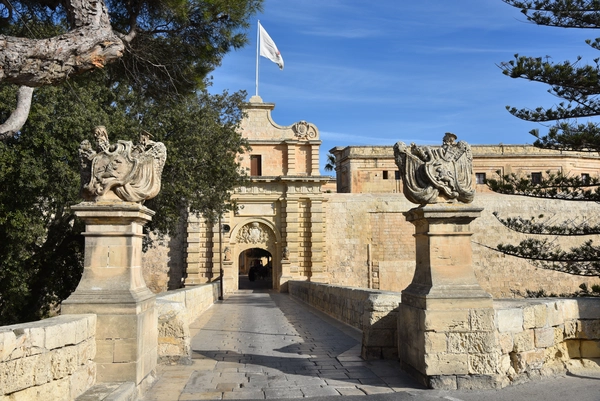
Gateway and bridge into Mdina
Also known as the Hospitaller Period, this era transformed Malta from a loosely rural archipelago into a heavily fortified and urbanized stronghold.
Historical Context
- The Knights of the Order of St. John arrived in Malta in 1530, granted the islands by Charles V of Spain.
- Their rule lasted until 1798, when Napoleon invaded Malta.
- Their focus was both military (defense against the Ottoman Empire and piracy) and spiritual/medical (running hospitals and providing religious services).
Key Environmental Themes (1530–1798)
Massive Fortification and Urban Expansion
Valletta and the Grand Harbour region:
- After the Great Siege of 1565, the Knights built Valletta (1570s) as a planned city on the Sciberras Peninsula.
- Fortified towns like Birgu, Senglea, and Cospicua were developed and enclosed by bastions.
Environmental impacts:
- Intensive quarrying: To supply stone for forts and walls.
- Loss of natural vegetation on coastlines and hilltops.
- Alteration of topography: leveling of ridges and construction on previously uninhabited promontories.
Water Management Innovations
Malta’s lack of freshwater sources pushed the Knights to implement:
- Wignacourt Aqueduct (1615): Brought water from Rabat/Dingli to Valletta; major engineering feat.
- Public fountains and reservoirs built across the islands.
- Rainwater harvesting systems in urban and rural buildings (cisterns under homes and palaces).
Impact:
- Helped support a growing urban population.
- Demonstrates early sustainable water engineering, though not enough to offset population growth.
Deforestation and Habitat Loss
When the Knights arrived:
- Malta had scattered woodlands and maquis (e.g., Holm oak, carob, Aleppo pine).
- Buskett Gardens (Verdala Palace area) was one of the last significant woodland areas.
Changes:
- Deforestation accelerated: Timber was used for shipbuilding, cooking, heating, and fort construction.
- Very few natural forests remained by the 18th century.
- Overgrazing by goats and sheep hindered regrowth of native trees and shrubs.
Agriculture and Rural Land Use
Despite their urban focus, the Knights encouraged agricultural development to reduce dependence on imports.
Practices:
- Dry-stone walling (ħitan tas-sejjiegħ) for soil retention and land terracing.
- Encouragement of crop rotation and olive/vine cultivation.
- Grants of land (benefices) for agricultural use under the Order’s feudal system.
Problems:
- Soil erosion due to hillside cultivation and deforestation.
- Expansion into marginal lands, especially in Gozo and the south of Malta.
Population Growth and Resource Strain
- Population grew steadily, reaching approx. 100,000 by the late 1700s.
- Urban centres (especially Valletta and the Three Cities) were densely populated, creating:
- Public health issues: open sewers, waste in streets.
- Food and water scarcity: Frequent famines and drought-related crises.
- Increased pressure on arable land and wood resources.
- Public health issues: open sewers, waste in streets.
Wildlife and Biodiversity Pressure
- Hunting was common among the nobility and knights.
- Migratory birds, once abundant, were hunted for sport and food.
- Native fauna (e.g., hedgehogs, reptiles, birds) declined in range due to habitat loss and predation.
Early Environmental Legislation (Minimal)
- No formal environmental protection laws existed.
- Some resource controls were in place:
- Regulations on cutting trees in Buskett.
- Grain storage and rationing during famines.
- Regulations on cutting trees in Buskett.
However, these were pragmatic rather than ecological.
Environmental Case Studies of the Period
Buskett Gardens
- One of the few areas where woodland was preserved.
- Originally used by the Knights as a hunting reserve.
- Contains species like holm oak, Aleppo pine, and carob.
Wignacourt Aqueduct
- Stretched 15 km from Dingli/Rabat to Valletta.
- Enabled sustained urban growth and sanitation in Valletta.
- Demonstrates the fusion of architecture, engineering, and resource planning.
Marsamxett and Grand Harbour Modifications
- Heavy coastal construction: docks, bastions, and wharves.
- Natural inlets and beaches modified or filled in.
- Sediment runoff from urban areas into harbours degraded marine habitats.
Summary Table of Environmental Changes
| Aspect | Status/Impact (1530–1798) |
|---|---|
| Urban development | High – Valletta and fortified towns led to major land alteration |
| Quarrying | Extensive – landscape modification and ecological disruption |
| Deforestation | Severe – woodlands cut for fuel, shipbuilding, and forts |
| Water management | Innovative – aqueducts, cisterns, early water planning |
| Agriculture | Sustained – but with erosion and pressure on marginal lands |
| Biodiversity | Decline – hunting, habitat loss, and invasive pressures |
| Environmental awareness | Low – conservation not a cultural priority, though some resource control existed |
Long-Term Environmental Legacy of the Knights
Positives:
- Lasting infrastructure (aqueducts, gardens, terraces)
- Historical landscapes like Buskett Gardens preserved
Negatives:
- Set the stage for Malta’s urban-centric development model
- Significant loss of original ecosystems
- Created resource management pressures still felt today (especially water)