Agriculture and Land Use
Vegetation and Deforestation
Water Management
Settlement and Urbanization
Livestock and Overgrazing
Marine Environment and Coastal Use
Biodiversity and Wildlife
Environmental Management and Laws
Case Study Sites
Summary Table: Environmental Change (2500 BCE–500 CE)
Long-Term Environmental Legacy
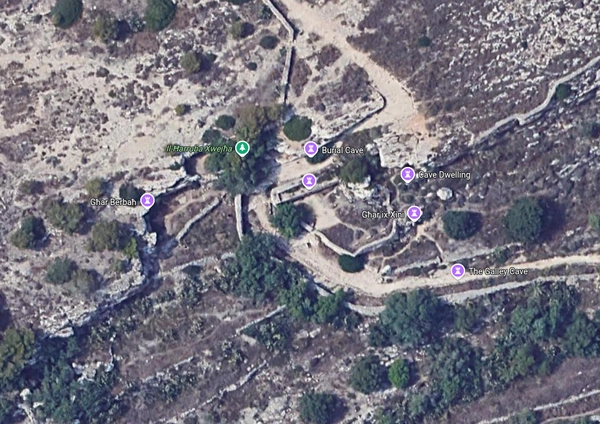
Google maps view of Punic-Roman site at Xemxija
Period Breakdown
| Period | Approx. Dates | Key Features |
|---|---|---|
| Bronze Age | 2500–700 BCE | Fortified settlements, early metallurgy |
| Phoenician/Carthaginian | 700–218 BCE | Maritime trade, harbours, new crops |
| Roman Period | 218 BCE–395 CE | Urbanization, aqueducts, villas, agricultural boom |
| Byzantine Period | 395–500 CE | Decline of Roman systems, transition to feudal rule |
Agriculture and Land Use
Bronze Age (2500–700 BCE)
- Shift from the organized temple-building society to small, fortified farming communities.
- Farming was largely self-sufficient: wheat, barley, lentils, and legumes.
- Use of terracing and dry-stone walling to manage the landscape and prevent erosion.
- Agriculture became more defensive and decentralized due to increased insecurity (e.g. climate change, raiding).
Phoenician–Carthaginian Era (700–218 BCE)
- Introduction of Mediterranean crops:
- Olives, grapes, figs, pomegranates.
- Olives, grapes, figs, pomegranates.
- Emphasis on export-oriented agriculture (e.g. olive oil, purple dye from murex shells).
- Likely increase in animal husbandry: sheep, goats, cattle.
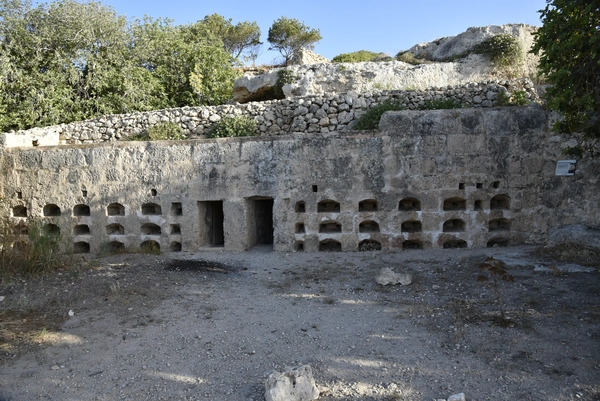
Punic-Roman Apiary at Xemxija. Photo © Stephen Yardley
Roman Era (218 BCE–395 CE)
- Malta becomes part of the Roman province of Sicilia.
- Roman villae rusticae (rural estates) were built in areas like San Pawl Milqi, Ramla, and Żejtun.
- Introduction of:
- Irrigation systems
- Large olive presses
- Storage cisterns
- Irrigation systems
- Efficient use of land: crop rotation, fertilization, and erosion control.
Environmental impacts:
- More intensive land use.
- Expanded deforestation to clear land for fields and construction.
Vegetation and Deforestation
- Malta likely had patchy woodland and maquis in earlier prehistoric times.
- By the Bronze Age, major deforestation was already underway due to:
- Firewood collection
- Agricultural clearance
- Grazing pressures
- Firewood collection
- During Roman times, deforestation likely intensified, especially in valleys and lower slopes.
- Coastal vegetation (e.g. juniper, lentisk, thyme) became dominant due to grazing and human activity.
Loss of native tree cover (e.g. holm oak, carob, olive) was widespread by the end of Antiquity.
Water Management
Bronze Age:
- Water collection was mostly reliant on wells and rock-cut cisterns.
- Some evidence of early dam-like structures or water catchments in valleys.
Phoenician–Roman Periods:
- Introduction of cisterns attached to urban buildings and villas.
- Roman engineering introduced channels and aqueducts (though Malta had no major aqueduct like later under the Knights).
- Romans constructed bathhouses, latrines, and public fountains — evidence of sophisticated water distribution.
Impact:
- Improved urban sanitation and agricultural productivity, especially in more fertile inland valleys.
Settlement and Urbanization
Bronze Age:
- Communities lived in hilltop fortified settlements (e.g. Borġ in-Nadur, Wardija).
- Settlement chosen for defensibility, not fertility.
Phoenician and Roman Periods:
- Emergence of coastal settlements and harbours (e.g. Marsaxlokk, Marsa, Tas-Silġ).
- Tas-Silġ became a religious and trading hub from Phoenician to Roman times.
- Urbanization increased under Roman rule:
- Melite (Mdina/Rabat) became a Roman municipium with paved streets, temples, baths.
- Melite (Mdina/Rabat) became a Roman municipium with paved streets, temples, baths.
Environmental consequences:
- Expansion of quarrying.
- Urban waste and drainage into valleys.
- Introduction of non-native plant species in gardens and estates.
Livestock and Overgrazing
- Goats, sheep, and cattle were common throughout the period.
- Grazing pressure contributed to:
- Suppression of forest regrowth
- Soil compaction
- Loss of topsoil on slopes
- Suppression of forest regrowth
Roman estates likely had large herds, as evidenced by animal remains and pastoral tools.
Marine Environment and Coastal Use
- Malta’s harbours became crucial during Phoenician and Roman times.
- Fishing, shellfish harvesting, and purple dye production (from Murex brandaris) were important industries.
Environmental impact:
- Overharvesting of shellfish.
- Coastal construction altered natural bays (e.g. slipways, warehouses).
- Marine pollution from urban waste and tannery byproducts.
Biodiversity and Wildlife
- Wildlife diversity declined due to:
- Habitat loss
- Hunting
- Domestication of land
- Habitat loss
Some native species like hedgehogs, reptiles, and birds survived in fragmented habitats.
- The Phoenicians and Romans likely introduced exotic plants and animals (e.g. rabbits, domestic cats, ornamental trees).
Environmental Management and Laws
- Bronze Age societies had no written laws, but likely observed customary land and water-sharing practices.
- Romans had a codified legal system:
- Property rights regulated land and water.
- Public utilities (aqueducts, roads) maintained by state officials.
- Lex Agraria (agrarian law) encouraged use of public lands.
- Property rights regulated land and water.
These systems promoted orderly land use, though environmental protection was not a priority.
Case Study Sites
| Site | Significance |
|---|---|
| Borġ in-Nadur | Fortified Bronze Age settlement with early field system remains |
| Tas-Silġ | Multi-period sanctuary used from Bronze Age through Roman era |
| San Pawl Milqi | Roman villa with olive press and storage cistern |
| Domvs Romana (Rabat) | High-status Roman house with mosaic floors and water systems |
Summary Table: Environmental Change (2500 BCE–500 CE)
| Environmental Aspect | Trend/Impact |
|---|---|
| Agriculture | Increasing intensification, new crops, and expanded estates |
| Deforestation | Steady loss of tree cover due to cultivation, livestock, and construction |
| Water management | Transition from basic cisterns to Roman systems with distribution and storage innovations |
| Urbanization | From scattered villages to structured towns with stone buildings and sewage systems |
| Biodiversity | Decline in forest and fauna, introduction of exotics |
| Environmental governance | Weak in early periods; structured under Roman law but with economic, not ecological, intent |
Long-Term Environmental Legacy
Positive Legacies:
- Agricultural terraces, Roman cisterns, and villae foundations still influence land use today.
- Introduction of staple crops (olives, grapes) and agrarian systems.
Negative Impacts:
- Permanent loss of native forest ecosystems.
- Onset of long-term soil erosion and habitat fragmentation.
- Foundations of urban waste problems in valleys and near coasts.