Background: Why the British Came to Malta
Key Environmental Themes (1800–1964)
Case Study Highlights
Summary of Environmental Impacts (1800–1964)
Legacy of British Period (Still Visible Today)
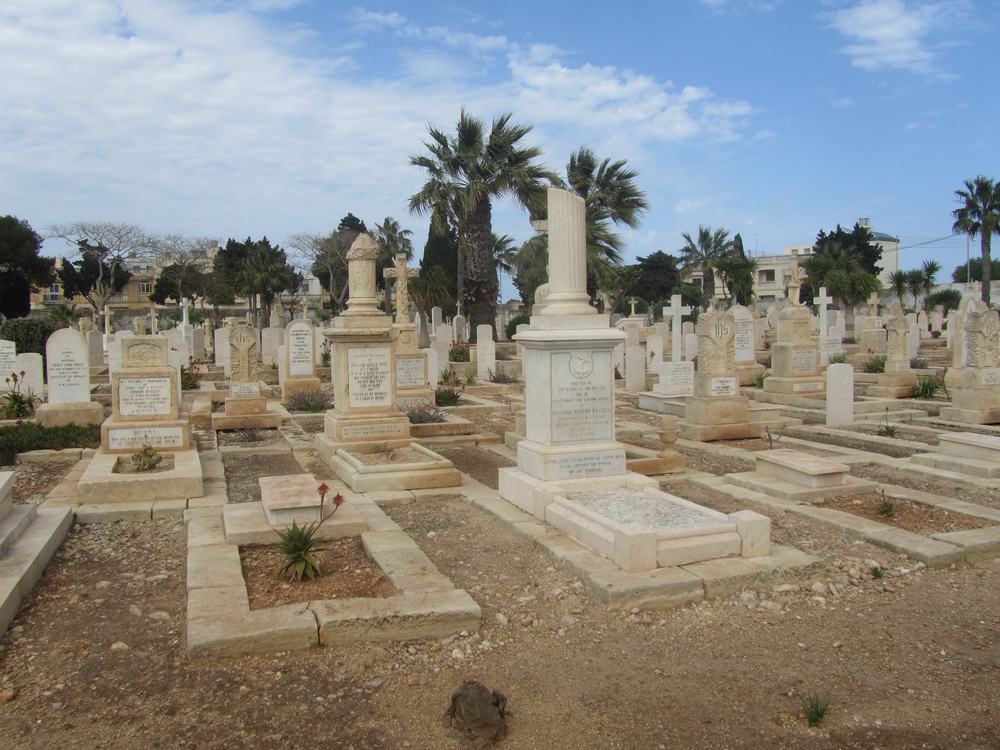
Kalkara military cemetery
Background: Why the British Came to Malta
- The British took control of Malta in 1800 after expelling the French.
- Malta's strategic location in the central Mediterranean was crucial for the British Empire—especially as a naval base linking Europe, the Middle East, and India.
- Became a British Crown Colony in 1813.
Key Environmental Themes (1800–1964)
Urbanization & Infrastructure Development
Expansion of urban areas:
- Valletta, Floriana, the Three Cities, and later Sliema, Gżira, and Hamrun expanded rapidly.
- Urban growth came at the expense of agricultural land and garigue habitats.
Major projects:
- Dockyard expansion: The Royal Navy established extensive dockyards in Cottonera and Marsa.
- Fortifications: Existing Knights-era fortifications were expanded or adapted for modern warfare.
- Water and sewerage systems: Initial improvements in sanitation; water infrastructure expanded, but remained under pressure from rising populations.
Environmental impact:
- Quarrying increased for construction materials (globigerina limestone).
- Displacement of natural vegetation, especially on the coasts and valleys.
- Emergence of urban pollution, including coal smoke and waste.
Maritime and Military Activity
Grand Harbour became one of the busiest naval ports in the British Empire.
Naval and shipping impacts:
- Oil spills, coal dust, and waste from ships contaminated marine ecosystems.
- Harbour dredging and land reclamation altered the natural coastline and sea beds.
Coastal military construction:
- Fort Ricasoli, Fort St. Elmo, Fort Rinella modernized or expanded.
- Construction of new barracks and naval installations (e.g., Fort Pembroke).
Agricultural Landscape and Rural Decline
Traditional agriculture (wheat, barley, figs, olives, vines):
- Still widespread, but increasingly marginalized by urban expansion and emigration.
- Irrigation methods remained traditional—no large-scale modernization.
Challenges:
- Land fragmentation due to inheritance laws (qabda) made farming inefficient.
- Soil erosion and deforestation continued, especially in sloping rural areas.
- Introduction of some non-native species (e.g., eucalyptus trees, prickly pear) for shade, soil stabilization, or fencing.
British efforts:
- Modest investment in rural development.
- Some experimental plantations and forestry trials, but few long-term successes.
Transport Infrastructure & Environmental Impact
Early infrastructure (1800–1900):
- Roads improved for military logistics—especially connections between harbours and inland forts.
- Early railway line (1883–1931): Valletta to Mdina (later closed due to rise in buses and cars).
Later developments (1900–1960):
- Road expansion and bus system introduced, increasing accessibility but also road dust and erosion.
- Vehicle use increased significantly post-WWII, contributing to air and noise pollution, especially in urban areas.
Industry and Environmental Stress
- Malta’s industrial base grew slowly under the British, mostly around ship repair, textiles, and military supply.
- Power generation relied on coal-burning stations, contributing to air pollution, especially around Marsa and Valletta.
- No environmental regulation: solid waste and sewage were often dumped untreated into valleys or the sea.
Wildlife and Biodiversity Impacts
- Overhunting: The British brought with them a sporting culture—hunting (especially bird shooting) became popular, leading to declines in native and migratory bird populations.
- Loss of biodiversity: Urban spread, quarrying, and military installations reduced habitat for native species.
- Introduction of alien species: Some plant and animal species were introduced for ornamentals or practical use (e.g., tamarisk, eucalyptus, rabbits).
Public Health and Sanitation Reforms
- British rule brought slow but steady improvements in public health:
- Cholera outbreaks in the 19th century led to better sanitation planning.
- Ta' Kandja and Chadwick Lakes built in the early 20th century to improve water storage and flood control.
- Drainage Master Plan (1867): One of the first planned sewerage systems, though not fully realized for decades.
- Cholera outbreaks in the 19th century led to better sanitation planning.
Case Study Highlights
Chadwick Lakes (Wied il-Qlejgħa)
- Built in the 1890s under British engineer Osbert Chadwick to retain water and reduce soil erosion.
- Important example of early eco-engineering.
Marsa Industrial Zone
- Originally marshland, later converted into an industrial and power-generating area—causing permanent loss of wetland habitat.
Summary of Environmental Impacts (1800–1964)
| Category | Impact |
|---|---|
| Urban expansion | High – loss of rural land and biodiversity |
| Maritime activity | High – water pollution, coastal alteration |
| Agriculture | Moderate – continued, but under strain from land fragmentation and erosion |
| Biodiversity loss | Moderate to high – hunting, habitat loss, invasive species |
| Infrastructure | Significant – roads, forts, waterworks, railway |
| Environmental laws | None – environment not legally protected |
Legacy of British Period (Still Visible Today)
- Urban footprint of dockyards, roads, and fortifications.
- Place names and building styles from British colonial architecture.
- Public infrastructure like roads, drainage channels, and reservoirs still in use.
- Ongoing issues from this era:
- Land degradation
- Marine pollution legacy
- Post-colonial sprawl into rural lands
- Land degradation